
October 22, 2026
A/B testing and CRO: how to get more from your website traffic
Graeme Knights, Head of Digital Marketing here at OneAgency, shares how CRO and A/B testing can help you get more from the traffic you already have.
While attracting quality visitors to your website may be a challenge, it is of course only half the challenge! What matters is what they do when they arrive and what they do before they leave.
Whether you’re investing in SEO, paid advertising or even a new website, visitors need to be encouraged to take meaningful action, from exploring your services to making an enquiry or completing a purchase.
Conversion rate optimisation (CRO) and A/B testing help businesses understand how visitors use their websites and identify improvements that can turn more traffic into customers. It is unlikely that a website, once built, will perform perfectly. It needs review, analysis and experimentation, it’s the little things that can keep you ahead of competitors. In the age of the ‘zero-click’ we need to ensure that the traffic that does come through to your website has every opportunity to convert without barriers.
What is…
Conversion rate optimisation (CRO)?
Conversion rate optimisation is the process of improving elements of a website to encourage more visitors to complete a desired action. For an e-commerce business, that might mean increasing purchases or for a service-based business, it could mean generating more enquiries, bookings or quote requests. It is about making your current site work harder for you.
CRO uses website analytics and user behaviour to identify opportunities for improvement, rather than relying on assumptions.
A/B testing?
A/B testing, also known as split testing, is a CRO technique that compares two versions of a webpage to determine which performs better
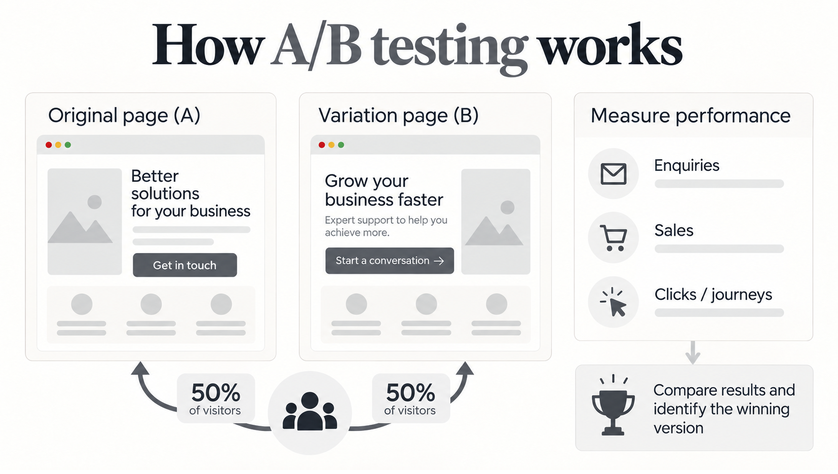
For example, a business might test whether changing a landing page headline or call-to-action (CTA) increases enquiries. Or they may want to reduce fields in a form, or even restructuring a whole page. It is about trying new things to see if a positive impact can be made.
Visitors are then randomly divided between two versions of the same website page:
- Version A: The original webpage.
- Version B: A modified version featuring the proposed change.
Both are measured against the same conversion goal, such as form submissions, purchases or clicks.
Once sufficient data has been collected, the results help businesses make evidence-based decisions about the changes to implement. Even a test that does not out-perform the original page should not be seen as a failure, as it still gives us learnings and data to move things forwards.
How can businesses improve through A/B testing?
A/B testing can improve different aspects of website performance, depending on business objectives. There are different elements that can be reviewed and tested for each problem needing solving. For example:
Generate more leads and enquiries
For lead-generation websites, landing page optimisation is key – testing headlines, CTA placement, enquiry forms and trust signals can help encourage visitors to get in touch. Small changes can often create big results.
For example, moving an enquiry button higher up a service page might increase form submissions without requiring additional traffic. Reducing fields in a form may reduce friction and encourage more completions.
This can be applied on a larger scale as well, changing navigation items to see if you can drive more traffic to key areas, changing page layouts and designs to see if a whole new approach would work. When testing, you should have an open mind and be prepared to be radical when required – it doesn’t have to be permanent!
Increase e-commerce sales
E-commerce conversion rate optimisation focuses on identifying and removing barriers to purchase. Even relatively small changes can influence purchasing decisions. It is important to review your product pages if you feel people are leaving them without taking action. Is the information clear enough? Is the way forward obvious? Is there any further information you could be presenting? Could you make delivery costs clearer? Do you describe the product enough, do you need any FAQs to help make the sale?
Online retailers can test product page layouts, delivery information, promotional messaging and basket experiences easily. Creating an effortless journey is key.
Once you feel the product page is working hard, you can then review the journey to checkout – can it be made simpler? Can you reduce basket drop outs? Fine tuning this can give uplift with minimum effort.
Improve website journeys
Not every visitor arrives ready to buy. Some discover a business through informational articles or organic search. But how do you get these visitors into the sales or conversion journey?
Adding relevant product links, service recommendations or CTAs can help visitors progress towards commercially valuable pages. You can trial soft or aggressive messaging to move people onto key site pages, making the most of your content pages and generating strong site engagement.
This is particularly useful for businesses investing in SEO and content marketing. Generating the visit to the site and then turning that visit into something more meaningful. Not only will it generate more value for your investment, but it will also help you understand the content that contributes to conversions and what is best for brand awareness and pure traffic drivers.
How does the CRO process work?
An effective CRO strategy follows four key stages to identify opportunities, test improvements, and increase website conversions :
- Identify opportunities: Analyse website traffic, user behaviour and conversion data to find areas for improvement. Understand the challenges and needs of the website.
- Develop and test: Create a hypothesis and create an alternate version of the page – using design or messaging changes to run the experiment. Split the traffic so that each page gets an equal share and then leave to run.
- Measure performance: Evaluate results against agreed goals, allowing sufficient time and traffic for reliable conclusions.
- Implement and improve: Apply successful changes and identify further opportunities.
Not every test produces a clear winner, but each experiment can provide useful insight into visitor behaviour.
When should businesses consider CRO?
CRO is particularly valuable for businesses already attracting website traffic through SEO, paid advertising or other marketing channels. Rather than increasing budgets to generate more visitors, CRO focuses on improving the value of existing traffic, getting the most out of the traffic that you are already paying for.
It can always be tempting to change once successful campaigns, if performance changes or costs go up. However before doing so, it is always worth reviewing their experience once they have clicked on the advert. As websites develop, visitors’ expectations change and it could be a website change that can get those campaigns firing once more.
It’s also worth considering after launching a new website. Even a well-designed website can benefit from improvements once real visitor behaviour becomes clear. A review several months after launch can help identify opportunities, although the right time to begin of course depends on traffic levels and available data. Here, data rules all – the more we have, the better we can make decisions, so don’t act rashly or before you really know things need to change. Wait for the data and then see what is really going on.
Frequently asked questions about CRO and A/B testing
-
CRO is the wider process of improving website conversions. A/B testing is one method used to measure the effectiveness of specific changes.
-
Common examples include headlines, CTA buttons, images, page layouts, forms, product information and promotional messaging. However you can go to many levels depending on your needs. If you want to revamp a whole page, you can try new ideas against your current benchmark.
-
It depends on traffic volumes, conversion rates and the improvement being measured. Tests need sufficient data to produce reliable results. Don’t get tied to ‘this is a 1 month test’ – you have collect as much data as required.
-
Higher traffic makes controlled testing easier. Lower-traffic websites can still benefit from CRO through analytics, usability reviews and other improvements. You may just need to be patient!
-
A/B testing doesn’t directly improve search rankings, but it can help businesses generate more value from organic traffic by improving landing pages and website journeys. Tests should follow search engine guidance to avoid creating SEO issues.
-
Improving your website conversion rate starts with understanding how visitors interact with your pages. Review analytics, identify where users abandon their journey and test improvements to page layouts, messaging, forms and calls to action. A/B testing can help establish which changes lead to more conversions.
Make more of your website’s potential
Attracting visitors takes time and investment. CRO helps businesses make better use of that traffic by improving how visitors interact with their websites.
At OneAgency, our conversion rate optimisation services combine digital marketing insight, website analytics and A/B testing to identify improvements that can generate more enquiries, customers and sales
Want to get more from your website traffic? Speak to the OneAgency team about conversion rate optimisation and A/B testing.